Refrigeration and cooling
Review loads, temperatures, suction conditions, defrost, condensers, evaporators and distribution.
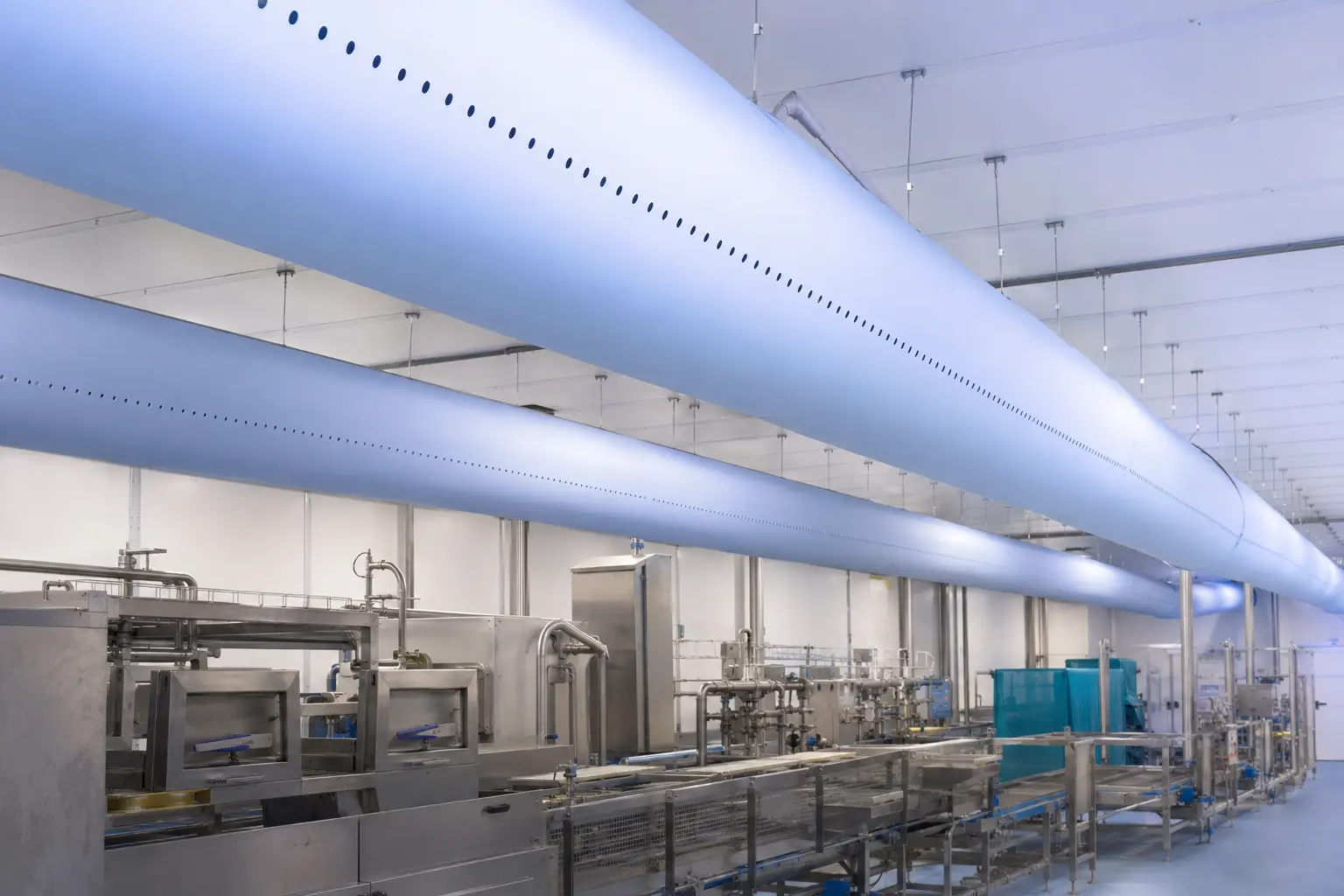
Technical assessment of refrigeration, cooling, steam, compressed air, ventilation, water and energy use in food-manufacturing facilities.
Oversized or poorly controlled systems can consume excessive energy while production still suffers unstable temperatures, low pressure, condensation or inadequate airflow. FFT Services examines demand, generation, distribution and point-of-use performance as one connected system.
The service helps factories experiencing high utility bills, insufficient capacity, uneven conditions, repeated alarms, condensation, product-temperature variation or planned production expansion.
Technical assessment of refrigeration, cooling, steam, compressed air, ventilation, water and energy use in food-manufacturing facilities.
Review loads, temperatures, suction conditions, defrost, condensers, evaporators and distribution.
Assess demand, pressure, traps, condensate return, insulation and heat-recovery opportunities.
Identify leakage, pressure loss, inappropriate use, control and compressor-loading concerns.
Evaluate heat, humidity, condensation, extraction, make-up air and fabric-duct distribution.
Review flow, pressure, temperature, pump control, cleaning demand and reuse opportunities.
Establish baselines, major users, operating drivers, priorities and measurement plans.
Collect production, utility, meter, equipment and operating-condition data.
Inspect systems and measure relevant pressure, temperature, flow, power or environmental conditions.
Separate operational corrections, maintenance actions and capital improvements by value and risk.
Define meters, indicators and comparison methods to confirm sustained results.
No saving should be guaranteed before measurements and operating data are reviewed. Opportunities are quantified with stated assumptions where sufficient evidence exists.
Yes. Refrigeration, compressed air, steam, ventilation, pumping or another defined system can be assessed independently.
Yes. Stable temperature, pressure, airflow and utility availability may improve capacity, quality, hygiene and equipment reliability as well as energy performance.
Share the product, process, equipment, present condition, available data and expected result. FFT Services will recommend an appropriate first step.